Autopilots by boat type
Autopilots for planing power cruisers
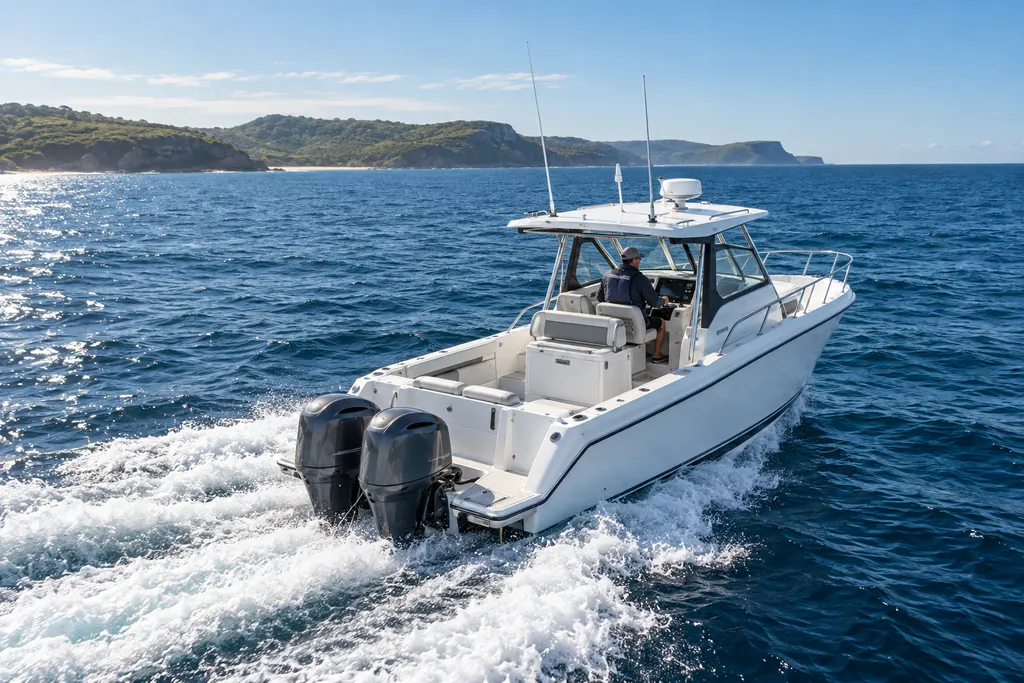
Compare autopilots for planing power cruisers and sportsfishers. Check hydraulic pump capacity, voltage, second stations and Australian installation budgets.
- Steering
- Hydraulic; some power-assisted or steer-by-wire
- Displacement
- 6,000–35,000 kg
- Recommended
- 4 systems
- Examples
- Riviera 39–52, Maritimo M50–M64, Caribbean 35–50
Planing cruisers and sportsfishers run hydraulic steering almost without exception, which makes the autopilot choice about pump size, voltage and integration rather than drive type. Most Australian-built boats of this kind leave the factory with a Garmin, Simrad or Raymarine pilot; refits and older imports are where the decision arises.
At 20–30 knots an autopilot that holds a straight wake is a fuel saving as well as a comfort. Route following through traffic, however, is where these boats get into trouble, because the closing speeds are high and the pilot does not see the fishing boat with no AIS.
Pump sizing and voltage
Pumps are sized to the steering cylinder volume and the you want. A planing hull needs a faster hard-over than a displacement cruiser, so installers pick a larger pump. Above about 12 m most cruisers run 24 V house systems, and every major brand offers 24 V pumps and course computers (Raymarine ACU-200/400, Simrad NAC-3, Garmin selected pumps, Furuno 711C).
Second stations and remotes
Flybridge boats need a control head at each station, or one head and a wireless remote. Garmin's GHC 50 and GPSMAP, Simrad's AP44/AP48 with NSS, and Raymarine's p70Rs with Axiom all support multiple stations on the network. Make sure Standby is one press away at every station.
- Garmin Reactor 40 with 2.0 L pump and Shadow Drive; GPSMAP at each station
- Simrad NAC-3 with AP44/AP48 and NSS; depth contour and turn patterns
- Raymarine EV-200 or EV-400 Power with p70Rs and Axiom
- Furuno NavPilot 711C for long-range and commercial-style operation
Route following at speed
The temptation on a fast boat is to set a route and let the pilot run it. The pilot will turn at every waypoint whether or not something is in the way. Treat route following as an aid to a watch, not a substitute, and set the turn-warning alarm so the helm confirms each waypoint. Inside Moreton Bay's channels and off Sydney's heads the traffic density makes this essential.
Wake and speed
Recommended
Systems that suit planing power cruisers
Shadow Drive and plotter integration make it the sportsfisher favourite.
Common factory fit on Australian cruisers; depth contour tracking for fishing.
The Power pack with a Type 1 pump suits mid-size cruisers on Raymarine networks.
- Undersized pumps that give a lazy hard-over on a planing hull
- One control head on a flybridge boat
- Blind route following in traffic
Questions
Frequently asked
Does my boat need a rudder reference?
Garmin and Simrad VRF packs work without one; Raymarine recommends one on hydraulic systems; Furuno uses Fantum Feedback on suitable boats. Larger cruisers with big cylinders generally benefit from a rudder reference regardless of brand.
Can the autopilot use joystick or steer-by-wire systems?
Yes, with the right pack. Garmin's Steer-by-wire pack supports Yamaha Helm Master, Volvo Penta, Mercury and SeaStar Optimus; other brands have equivalent interfaces. The engine or steering supplier usually specifies which.
Recommended systems at a glance
- Below-deck systemGarmin
Garmin Reactor 40 (Hydraulic, Mechanical, Steer-by-wire and Sail)
- Indicative
- $2,900–$5,200
- Editor score
- 83
- Below-deck systemSimrad
Simrad AP44 with NAC-2 or NAC-3
- Indicative
- $3,300–$5,800
- Editor score
- 77
- Below-deck systemRaymarine
Raymarine Evolution EV-200 (Sail and Power)
- Indicative
- $5,900–$7,600
- Editor score
- 80
- Below-deck systemFuruno
Furuno NavPilot 711C
- Indicative
- $4,500–$6,800
- Editor score
- 73
Where these boats sail
Other boat types
Autopilot commissioning and boat-specific training
Every boat type above ends with the same advice: a handover on the water, a settings card, alarms set and a failure drill. The training section explains what good instruction looks like and where to find it.