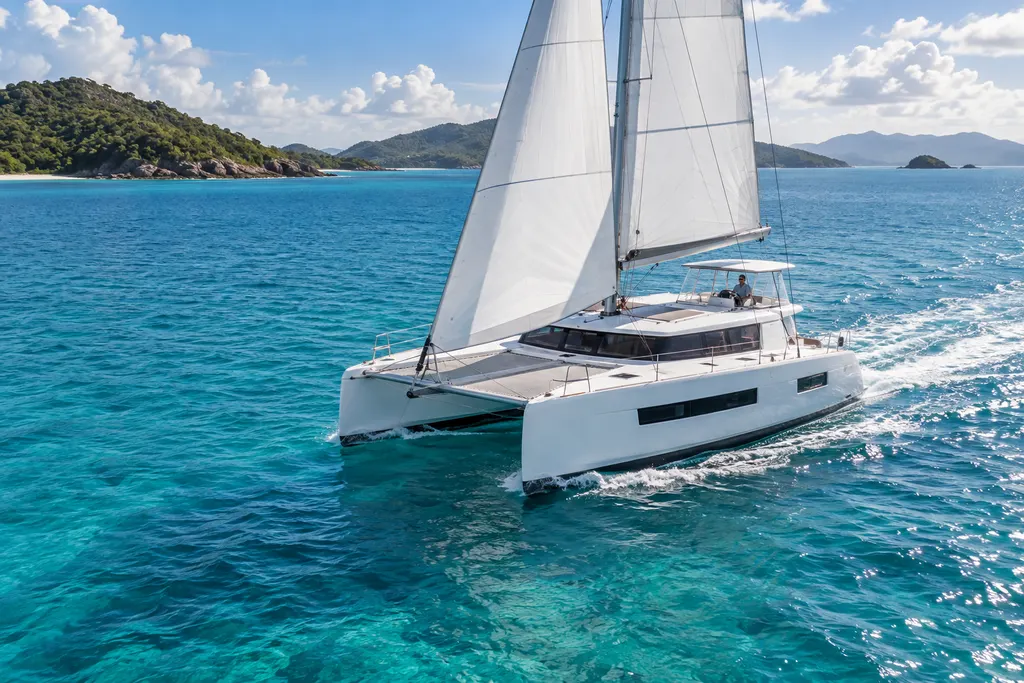
Autopilots by boat type
Catamaran autopilot systems
Compare catamaran autopilot systems for linked twin rudders. Review drive selection, steering demand, wind modes, power budgets and Australian model options.
- Steering
- Twin rudders linked by a tie bar; mechanical or hydraulic helm
- Displacement
- 6,000–20,000 kg
- Recommended
- 4 systems
- Examples
- Seawind 1160, 1260 and 1370, Lightwave 38 and 45, Lagoon 40–450
Australia builds and sails more cruising catamarans per head than almost anywhere, and the autopilot conversation on a cat is different. Two rudders, a , often a hydraulic helm, high speeds downwind, a big solar array and a stern that makes a windvane awkward all push the choice towards a well-sized electronic below-deck system and away from anything that clamps to a wheel.
The usual installation is a single on one rudder stock, with the carrying the load to the other rudder, or a hydraulic pump where the boat has hydraulic steering. Builders like Seawind and Lightwave have standard fits; ask what they specify before improvising.
One drive, two rudders
A single on one stock is the norm and it works because the is stiff. The drive must be sized for both rudders and the rudder reference must read the stock that the drive pushes. Some heavier cats fit a drive on each stock with a single course computer; that is a builder-level decision, not an aftermarket one.
Hydraulic helms take a pump exactly as on a monohull. Raymarine, Garmin, B&G and Simrad all have hydraulic packs; sizing is by cylinder volume.
Speed, gain and the downwind problem
Cats accelerate in gusts and the swings forward fast, so wind steering needs a pilot that reacts quickly and a wind sensor that is not lagging. B&G's and Raymarine's both help. Under spinnaker or screecher downwind, most cat skippers steer to rather than apparent, and set response higher than on a monohull.
Catamaran autopilot electrical supply and cable sizing
Most cruising cats now carry 800 W or more of solar and lithium banks, so the 2–4 A a pilot draws on a fast passage is easily covered. What matters more is voltage drop on the long cable runs from the battery to a drive at the stern. Size the cable properly.
- Single linear drive on one rudder stock, tie bar transfers load
- Rudder reference on the driven stock, linkage parallel and stop-protected
- Hydraulic pump where the helm is hydraulic
- Cable sized for the run; check voltage at the drive under load
- Wind sensor high and clear of the rig; true-wind steering downwind
Windvane steering limitations on catamarans
Multihulls are light, fast and wide-sterned, and their is unstable. Windvanes exist for cats but are rare and rarely satisfying. Cat cruisers leaving Australia for the Pacific almost universally rely on a strong electronic pilot with spares and a second control head.
Carry a spare drive
Recommended
Systems that suit catamarans and multihulls
Standard on many Australian-built cats; the Type 1 drive suits cats to about 11 tonnes loaded.
For performance cats and anyone steering to true wind downwind.
Hydraulic packs suit cats with hydraulic helms and Garmin plotters.
- Above-deck wheel pilots on a cat's exposed helm
- A single small drive sized for one rudder
- Windvanes unless you have specific advice for the boat
Questions
Frequently asked
Does my Seawind need a special autopilot?
No, but the builder has a standard installation and drive size for each model. Start with that; it saves engineering.
Should a cat steer to true or apparent wind?
Downwind, true wind. Apparent wind on a fast cat swings so much that an apparent-wind pilot chases it. Upwind, apparent is fine.
Recommended systems at a glance
- Below-deck systemRaymarine
Raymarine Evolution EV-200 (Sail and Power)
- Indicative
- $5,900–$7,600
- Editor score
- 80
- Below-deck systemB&G
B&G NAC-3 Autopilot (Triton2 Pilot Controller)
- Indicative
- $4,300–$5,300
- Editor score
- 77
- Below-deck systemGarmin
Garmin Reactor 40 (Hydraulic, Mechanical, Steer-by-wire and Sail)
- Indicative
- $2,900–$5,200
- Editor score
- 83
- Below-deck systemRaymarine
Raymarine Evolution EV-400
- Indicative
- $8,500–$14,000
- Editor score
- 77
Where these boats sail
Other boat types
Autopilot commissioning and boat-specific training
Every boat type above ends with the same advice: a handover on the water, a settings card, alarms set and a failure drill. The training section explains what good instruction looks like and where to find it.