Choosing · 6 minute read
Catamaran autopilot installation
Plan catamaran autopilot installation around linked rudders, drive geometry, wind data, cable runs and power. Review practical checks before specifying hardware.
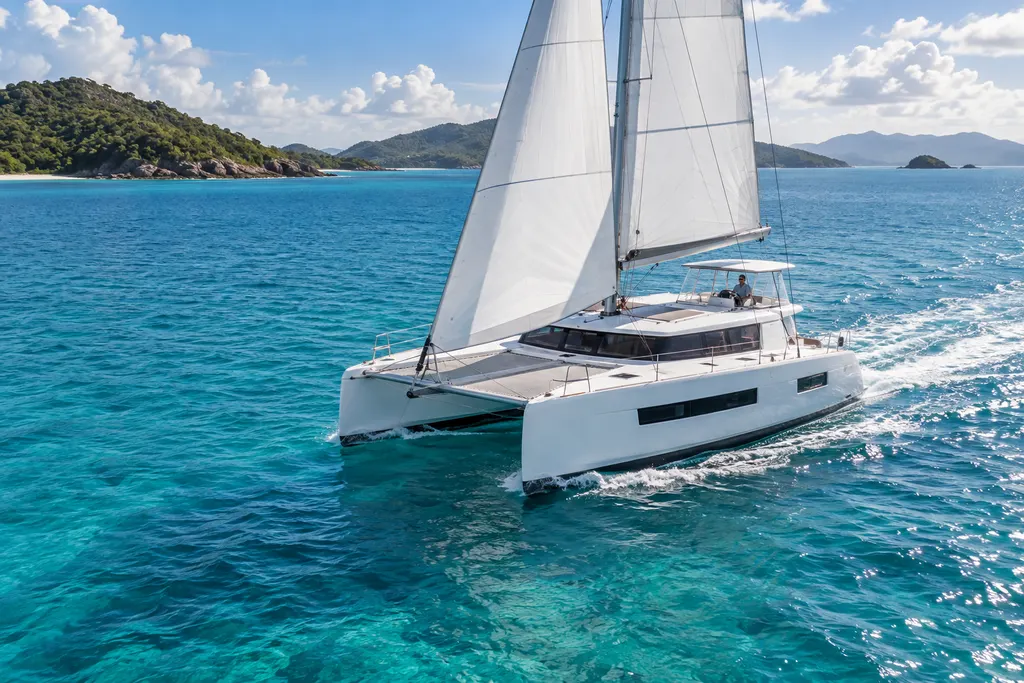
Australia is a catamaran country. Seawind, Lightwave and a generation of Schionning and Grainger designs are built here, and the Lagoon and Fountaine Pajot fleets fill Queensland marinas. Autopilot choice on a cat is shaped by twin rudders on a , often a hydraulic helm, high speeds that swing the , long cable runs to the sterns and a stern shape that rules out most windvanes.
The good news is that cats are easy boats to steer: light helm, little weather helm, and lots of solar. The autopilot has to be sized and installed for the twin-rudder geometry and tuned for the boat's speed, and then it becomes the most reliable crew member aboard.
Key facts
- Rudders
- Two, linked by a tie bar; one drive usually suffices
- Helm
- Mechanical or hydraulic; pump or linear drive accordingly
- Wind mode
- True wind downwind; apparent swings too fast
- Power
- 2–4 A on passage; long cable runs need sizing
- Windvane
- Rarely satisfactory on a multihull
Catamaran drive, rudder tie bar and feedback installation
The standard installation is a on one rudder stock, with the carrying the load to the other rudder. The drive is sized for both rudders and the boat's loaded displacement. The rudder reference goes on the driven stock with a rigid, parallel linkage. Some builders and owners fit twin drives on heavier cats; that is a builder-level decision requiring a course computer that supports it.
Cats with hydraulic helms take a reversible pump exactly as a monohull would. Sizing is by cylinder volume; Raymarine, Garmin, B&G and Simrad all have suitable packs.
Catamaran speed and true-wind data requirements
A cruising cat that accelerates from 7 to 12 knots in a gust swings its forward by tens of degrees. A pilot steering to apparent wind chases the swing and can bear away or round up at the wrong moment. Steer to downwind, and make sure the wind sensor is calibrated and mounted clear of the rig; on a cat the masthead is a long way from the water and the sensor can lag.
Response should be set a notch higher than on an equivalent monohull. B&G's and Raymarine's both earn their keep.
Catamaran autopilot power cables and spare parts
Most cruising cats have generous solar and lithium, so consumption is rarely the issue. Voltage drop is: the drive sits at the stern, the batteries are often forward or in a hull, and the run can be ten metres. Size the cable for the drive's peak current over that run and check voltage at the drive under load.
Serious cat cruisers carry a spare drive and know how to fit it. On a boat where the pilot steers 95 per cent of the miles, the spare is the crew.
- Single linear drive on one stock, tie bar transfers load
- Rudder reference on the driven stock
- Cable sized for the run; voltage checked under load
- True-wind steering downwind; response one notch up
- Spare drive aboard; swap practised at the dock
- Second control head or remote at the other helm
Autopilot installation considerations for Australian catamarans
Seawind and Lightwave both have standard autopilot specifications for each model, usually Raymarine Evolution with a Type 1 or hydraulic drive, sometimes B&G on performance-oriented boats. Ask the builder what they fit and why before you improvise; they have solved the geometry. On imported cats, the charter-spec pilot is often the minimum and worth upgrading at first refit.
Windvanes on cats
Questions
Frequently asked
Do I need two drives on a catamaran?
Usually not. One linear drive on a tie-barred twin rudder system is the standard on cruising cats to about 12 tonnes. Heavier cats may use twin drives; ask the builder.
Should my cat steer to true or apparent wind?
True wind downwind, always; apparent upwind is fine on most cats.
Can I fit a windvane to my cat?
Some owners have. Most regret it. A strong electronic pilot with a spare drive is the accepted answer.
Practise autopilot operation with an instructor
Habits are learned at the helm with someone watching. The training section explains what a good instructor covers and where to find one in your state.