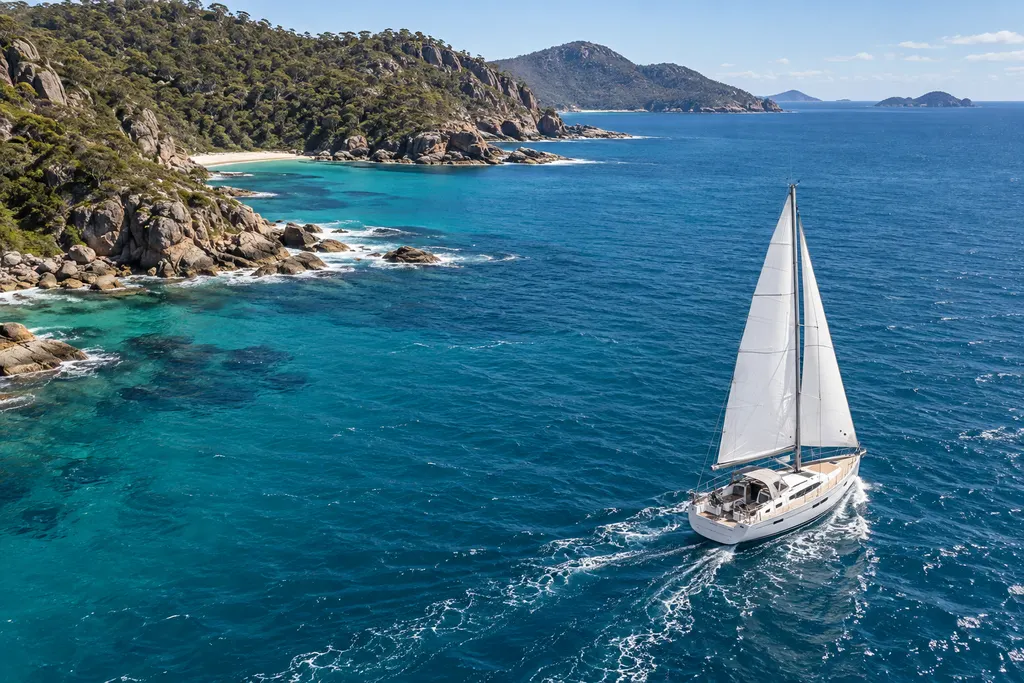
Below-deck system · Raymarine
Raymarine Evolution EV-200
A proper below-deck autopilot for cruising yachts and cruisers to about 11 tonnes.
- Indicative price
- $5,900–$7,600 unit
- Fitted
- $7,500–$11,000
- Rated for
- Vessels to 11 t
- Editor score
- 80 / 100
The EV-200 is where Raymarine's Evolution family becomes a serious offshore autopilot. The ACU-200 course computer runs on 12 or 24 V and drives a Type 1 mechanical (Sail pack) or a Type 1 hydraulic pump (Power pack). The linear drive bolts to a below-deck on the rudder stock and pushes the rudder directly, with none of the belt slip, noise or exposure of an above-deck wheel drive.
For an Australian cruising yacht heading north to the Whitsundays, across to Lord Howe or down to Tasmania, this is the sensible minimum. It steers for days without complaint, holds a course in a following sea that would have a wheel pilot hunting, and the Type 1 drive has a clutch you can disengage instantly to take the helm by hand.
It is not a racing pilot, and it needs a proper installation: a , a strong mounting pad glassed or bolted to the hull, and rudder-stop protection so the drive cannot overtravel. Done well, it is the autopilot that owners of 35–45 foot cruising yachts stop thinking about, which is the highest compliment an autopilot gets.
Verdict
Raymarine Evolution EV-200 (Sail and Power) drive sizing
Type 1 : sailing yachts to 11,000 kg (24,250 lb). Type 1 for chain-and-cable steering to the same limit. Type 1 hydraulic pump for cylinders of roughly 80–230 cc.
Specifications
Autopilot components, voltage and steering modes
- Sensor
- EV-1 nine-axis sensor core
- Course computer
- ACU-200, 12/24 V, for Type 1 linear, rotary and hydraulic drives
- Control
- p70s or p70Rs head, or Axiom MFD
- Drive
- Type 1 mechanical linear drive with clutch, or Type 1 hydraulic pump
- Feedback
- Rudder reference transducer (required for Type 1 drives)
- Voltage
- 12 V or 24 V DC
- Network
- SeaTalkng, NMEA 2000 (via adaptor), NMEA 0183 via converter
- Power draw
- 2 A typical, 10 A peak. Linear drive averages 1–3 A under way depending on sea state; peaks briefly when the clutch engages and the drive reverses.
- Steering systems
- Mechanical wheel (cable, chain or rod); Tiller; Hydraulic
Modes
- Auto (heading)
- Wind vane (true or apparent)
- Track (route following)
- AutoTack / AutoGybe
- Pattern steering on power packs
Features
- Below-deck linear drive with instant manual override via the clutch
- 12/24 V operation for larger boats
- Evolution AI and Hydro-Balance tuning
- Full wind steering with a Raymarine or NMEA 2000 wind sensor
- Compatible with Axiom for route following and alarms
For and against
Autopilot strengths and limitations
- Genuine offshore-grade course keeping for the price
- Quiet and out of the weather
- Manual override is instant and mechanical, not electronic
- Dealers in every Australian capital stock drives and spares
- Installation is a real job, particularly on a boat with no tiller arm
- Type 1 drive rated to 11 tonnes; heavy cruisers need the EV-400
- Linear drive can be overwhelmed on a very fast planing hull; use the hydraulic pack
Who fits it
Boats and places where this system is recommended
Boat types
- Wheel-steered cruising yachts → The complete below-deck pack most Australian yacht dealers install and service; ideal for 7–11 tonne cruisers.
- Catamarans and multihulls → Standard on many Australian-built cats; the Type 1 drive suits cats to about 11 tonnes loaded.
- Planing power cruisers → The Power pack with a Type 1 pump suits mid-size cruisers on Raymarine networks.
Australian waters
- New South Wales → The below-deck pack for the ex-charter cruiser fleet heading north each winter.
- Victoria → Below-deck reliability for cruisers crossing to Tasmania.
- Queensland → The cruising cat and monohull standard for the winter season inside the Reef.
- Western Australia → For the Fremantle cruising fleet heading north in winter.
- South Australia → For gulf cruisers making the long legs to Port Lincoln and Kangaroo Island.
- Tasmania → Below-deck reliability for Storm Bay, the east coast and Bass Strait.
- Northern Territory → For cruising yachts staging for Indonesia.
- Sydney and Pittwater → For the 42 to 47 foot cruiser doing real coastal hops to Port Stephens and Jervis Bay. A below-deck drive holds a following sea off Long Reef where an above-deck unit runs out of authority.
- NSW South Coast: Jervis Bay to Eden → The workhorse choice for a 40 to 46 foot cruiser staging for Bass Strait. Below-deck authority and a proper rudder reference are what keep a boat tracking in a following sea on the long leg to Eden.
- Melbourne and Port Phillip → The sane cruising answer for a 40 to 46 foot boat that does the bay in summer and the east coast route to Tasmania in December. Below-deck authority matters once the sea gets behind you off the Prom.
- Gippsland Lakes and Bass Strait → The sensible below-deck system for a 40 foot cruiser crossing to Flinders Island or heading west around the Prom. It has the authority to hold a quartering Bass Strait sea that an above-deck unit will not.
- Sunshine Coast and Fraser Coast → The standard fit for a 42 to 46 foot cruiser making the trip north. A below-deck drive handles the downwind trade wind legs where an above-deck unit runs out of authority and out of amps.
Questions
Raymarine Evolution EV-200 (Sail and Power): frequently asked
Does the EV-200 Sail pack need a rudder reference?
Yes. Raymarine requires a rudder reference transducer with Type 1 linear and rotary drives so the course computer knows the exact rudder angle. It is a small extra cost and worth fitting properly with a rigid linkage.
Can I use the EV-200 on a catamaran?
Yes. Catamarans with two rudders linked by a tie bar usually take one linear drive on one rudder stock. Very wide or heavy cats, or those with hydraulic steering, may suit a hydraulic pump instead. Ask the builder what they fit.
What is the difference between the ACU-200 and the ACU-100?
The ACU-200 handles more powerful Type 1 drives and runs on 12 or 24 V, which is why it is required for below-deck linear and rotary drives. The ACU-100 is 12 V only and drives the smaller EV-100 tiller and wheel drives.
Alternatives to consider
The systems most often weighed against this one.
- Below-deck systemB&G
B&G NAC-3 Autopilot (Triton2 Pilot Controller)
- Indicative
- $4,300–$5,300
- Editor score
- 77
- Below-deck systemGarmin
Garmin Reactor 40 (Hydraulic, Mechanical, Steer-by-wire and Sail)
- Indicative
- $2,900–$5,200
- Editor score
- 83
- Below-deck systemRaymarine
Raymarine Evolution EV-400
- Indicative
- $8,500–$14,000
- Editor score
- 77
Other below-deck system systems
- Below-deck systemRaymarine
Raymarine Evolution EV-150 Hydraulic
- Indicative
- $3,900–$4,900
- Editor score
- 70
- Below-deck systemB&G
B&G NAC-2 Autopilot (Triton2 Pilot Controller)
- Indicative
- $3,400–$4,200
- Editor score
- 70
- Below-deck systemSimrad
Simrad AP44 with NAC-2 or NAC-3
- Indicative
- $3,300–$5,800
- Editor score
- 77
- Below-deck systemFuruno
Furuno NavPilot 711C
- Indicative
- $4,500–$6,800
- Editor score
- 73
Head to head
Comparisons featuring this system
Autopilot commissioning and operator training
A $11,000 installation with no handover is a gamble. Half a day on the water with the installer or an instructor covers the modes, the override, the alarms and a failure drill. It is the cheapest safety equipment aboard.