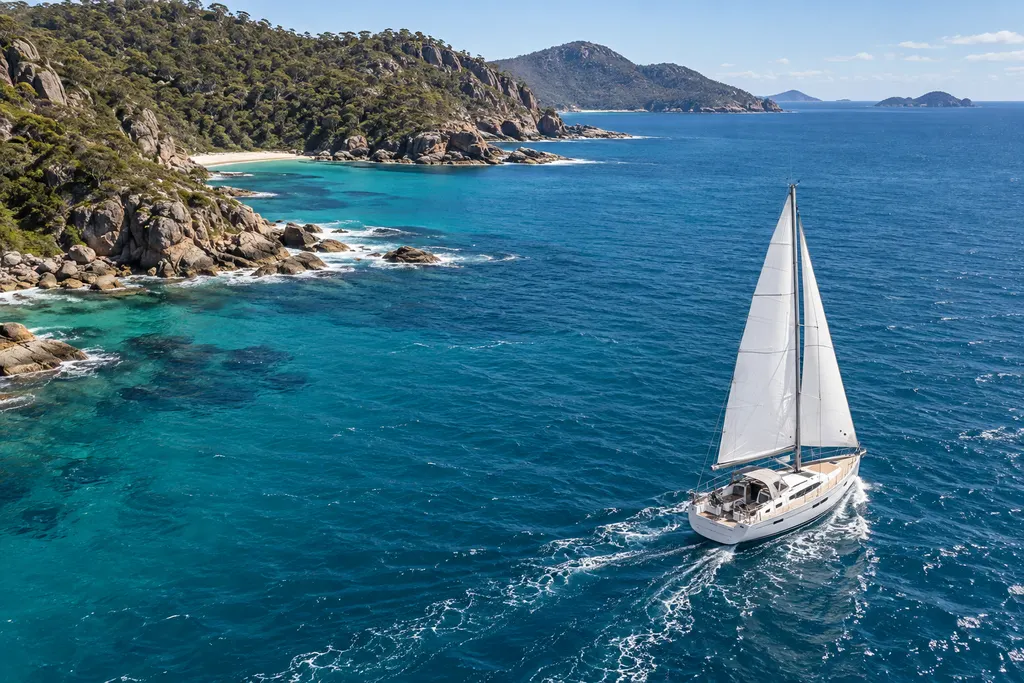
QLD · Regional guide
Marine autopilots the Whitsundays and Mackay
Trade winds, big tides and reef navigation: choosing and using an autopilot from Mackay Marina to Airlie Beach, the Whitsunday Passage and the outer reef.
- State
- Queensland
- Waters
- The Whitsunday Passage and the island group, Airlie Beach and Shute Harbour, Hamilton Island and the Molle group
- Recommended
- 4 systems
- Reviewed
- September 2026
The Whitsundays look like a postcard and sail like a wind tunnel. Through the dry season the south-east trades funnel between the islands at 20 to 30 knots for days on end, and the tide runs hard through the passages with them or against them. It is superb sailing and it asks a lot of an autopilot.
Tides here are the biggest on the east coast. Around Mackay the range on a spring tide runs to six metres and more on the biggest springs, which means real streams through the passages, big differences between chart datum and what you see, and anchorages that look different at each end of the day.
The other local reality is the charter fleet. Thousands of people sail here each year on bareboats, many with limited experience and many on boats without autopilots at all, which is worth remembering when you are the one who is steering itself through the passage at dusk.
Waters covered
- The Whitsunday Passage and the island group
- Airlie Beach and Shute Harbour
- Hamilton Island and the Molle group
- Mackay Marina and the Hay Point approaches
- Bowen and Gloucester Passage
- The outer Great Barrier Reef
Browse all places on this map
Local planning notebook
Autopilot passage and installation planning in Whitsundays and Mackay
In an island itinerary, do not assume a familiar brand means familiar controls. Ask the operator which modes are permitted and how manual takeover works on this particular boat. Keep route and anchorage planning separate from the convenience of automatic steering.
What to ask at the handover
Have every intended watchkeeper identify the active mode and demonstrate standby under the operator’s guidance. Report unexpected steering rather than changing calibration settings on a charter boat.
An unfamiliar helm →Before leaving Whitsundays and Mackay
This is planning context, not a live forecast or navigation instruction. Check the information that can change before each trip.
Maritime Safety Queensland ↗Bureau of Meteorology marine forecasts ↗Prepare a brief for a local installer →Regional equipment suggestions are editorial starting points. They do not identify a local branch, approved installer or business affiliation.
Whitsundays and Mackay wind, tidal streams and reef routes
From May to September the trades are the weather. They reinforce overnight, ease mid-morning and build again in the afternoon, and 25 knots is an ordinary day rather than a warning. Downwind through the passage in that breeze, an under-tuned pilot will roll into a broach-and-recover cycle that is uncomfortable at best. This is a region where wind steering modes genuinely help, because they keep the apparent angle constant as the boat surfs.
Tidal streams run at a couple of knots through the narrow passages and more on the springs. Wind against tide in Hook Passage or the Whitsunday Passage makes a short, steep sea that appears from nowhere. Plan transits with the stream and use track steering so the set shows as cross-track error early, rather than discovering it when the island is not where you expected.
Then there is coral. Fringing reef extends further from the islands than newcomers believe, bommies sit in unexpected places, and light conditions decide whether you can see them. No autopilot mode substitutes for eyeball navigation with the sun behind you. Between November and April the cyclone season adds a separate planning layer entirely.
- South-east trades 20 to 30 knots for long stretches of the dry season
- Spring tidal ranges of six metres and more around Mackay, with strong streams
- Wind against tide chop in Hook Passage and the Whitsunday Passage
- Fringing reef and isolated bommies close to popular anchorages
- Cyclone season from November to April
Sun angle beats any electronic aid
Whitsundays charter and Mackay fishing boat autopilot needs
The bareboat fleets run monohulls and catamarans from about 38 to 50 feet, and many are deliberately kept simple, with no autopilot fitted, because charter companies want crews steering and looking. Private cruising boats are the opposite: shorthanded couples working north or south, using the pilot for most of the day and relying on it completely.
Around Mackay the mix shifts to trailer boats, sportfish boats running out to the reef and a commercial fishing fleet. Those boats want hydraulic pilots that hold a course while gear is worked, and that can be overridden in a heartbeat when a crab pot float appears.
- Cruising monohulls 38 to 50 ft: below-deck drive with wind and track modes
- Cruising catamarans: below-deck drive sized for the linkage, high rudder gain
- Racing boats visiting for the regatta weeks: fast response sailing pilot
- Mackay sportfish and trailer boats: hydraulic or outboard pilot with override
Recommended
Systems that suit Whitsundays and Mackay
The sensible system for a 42 to 48 foot cruiser working the islands. It has the authority to hold a downwind course in 25 knots of reinforced trade with the tide under the quarter.
For a sailing boat under about 38 feet that wants proper wind steering through the passage. Holding a constant apparent angle downwind in the trades is exactly what this core pack does well.
Enough for a smaller cruiser doing island hops in settled conditions, and a common retrofit on boats that spend the wet season on a mooring. Do not expect it to hold a heavy boat surfing in 28 knots.
The pick for a Mackay-based power boat running out to the reef. Shadow Drive suits water where you are constantly dodging pot floats, and the pack handles the hydraulics on most local sportfish boats.
Passages
Typical local passages and the autopilot on each
Airlie Beach to Hamilton Island
A short hop that crosses the main passage and its tidal stream. Use track steering so the set is obvious, watch for charter boats making unpredictable alterations, and expect the wind to accelerate between the islands. Approach the marina by hand with fenders and lines ready.
Through Hook Passage
Narrow, tidal and spectacular. Transit near slack or with the stream, keep the pilot on a short leash, and plan for a wind shift as you clear the gap. In wind against tide the water here stands up sharply enough to slow a small boat to a crawl.
Mackay to the Whitsundays overnight
A comfortable 60 miles that crosses the approaches to a major coal port. Ships arrive and depart on schedule and use defined routes, so plan your track to cross them squarely and keep AIS running. Set an off-course alarm and keep a real watch, because the pilot will hold a course into a shipping route just as well as away from one.
Out to the outer reef
Long enough that everyone wants the pilot on for the crossing. Set up the route, then close the reef in good light with the pilot off and a lookout up forward. Reef entrances are eyeball navigation, and the last half mile is the part that damages boats.
- Fringing reef and isolated bommies, often poorly visible in flat light
- Strong tidal streams through the island passages, more on the springs
- Coal ships in the Hay Point approaches and the defined shipping routes
- Charter boats making unexpected alterations, including under sail
- Humpback whales during the winter and spring months
- Cyclone season from November to April, with rapid escalation
Whitsundays charter autopilot briefings and instruction
Airlie Beach has an unusual concentration of instruction because of the charter industry. Australian Sailing affiliated clubs, RYA recognised training centres and commercial skipper schools all operate in the region, and the bareboat briefing culture means there are plenty of instructors who teach boat handling on someone else’s boat for a living. Race weeks at Hamilton Island and Airlie Beach also bring crew training opportunities.
For the pilot itself, use an installer at Mackay Marina or in the Airlie precinct and insist the handover happens in the trades. Indicative costs: half-day handover $300 to $600, private on-water tuition $90 to $150 an hour, RYA Day Skipper practical over five days $1,800 to $2,600. Confirm with the provider before booking.
- Ask for the sea trial downwind in 20 knots, which is the condition that exposes tuning
- Learn wind mode properly, including what it does at a gybe
- Practise anchoring approaches by hand, with the pilot off and the crew forward
- Know your tidal heights for every anchorage, not just the passage plan
Questions
Whitsundays and Mackay: frequently asked
Why do bareboats often have no autopilot?
Charter operators want crews hand steering and keeping a lookout in reef waters, and simpler boats are easier to maintain across a big fleet. If you are used to a pilot at home, plan for longer, more tiring days and share the helm properly.
How strong are the tides around Mackay?
Among the largest on the east coast, with spring ranges of six metres and more. That produces real streams through the passages and big differences in anchoring depth over a day. Work the tide into every passage plan rather than treating it as a detail.
Can I use waypoint steering near the reef?
Between islands in deep water, yes. Approaching coral, no. Reef navigation depends on light, eyes and a slow boat, and a pilot following a route cannot see a bommie that is two metres under the surface and not on the chart.
What about cyclone season?
From November to April, plan around the Bureau of Meteorology tropical outlooks and have a cyclone plan for the boat. Many owners move south or into an approved storm berth. An autopilot is not part of that conversation, but your insurance conditions almost certainly are.
Recommended systems at a glance
- Below-deck systemRaymarine
Raymarine Evolution EV-200 (Sail and Power)
- Indicative
- $5,900–$7,600
- Editor score
- 80
- Below-deck systemB&G
B&G NAC-2 Autopilot (Triton2 Pilot Controller)
- Indicative
- $3,400–$4,200
- Editor score
- 70
- Wheel pilotRaymarine
Raymarine Evolution EV-100 (Tiller, Wheel and Power)
- Indicative
- $2,900–$3,900
- Editor score
- 77
- Below-deck systemGarmin
Garmin Reactor 40 (Hydraulic, Mechanical, Steer-by-wire and Sail)
- Indicative
- $2,900–$5,200
- Editor score
- 83
Nearby regions in Queensland
Instruction in Whitsundays and Mackay
The training section explains what a good instructor covers and the ten questions that sort them. Ask for a session on your own boat, in a seaway, with a failure drill.