
Product comparison
Raymarine ST2000+ vs EV-100 Tiller
Compare Raymarine ST2000+ and EV-100 Tiller systems: heading sensors, drive layout, boat sizing, power, installation and indicative Australian upgrade costs.
- Option 1
- Raymarine ST2000+
- Option 2
- Raymarine EV-100 Tiller
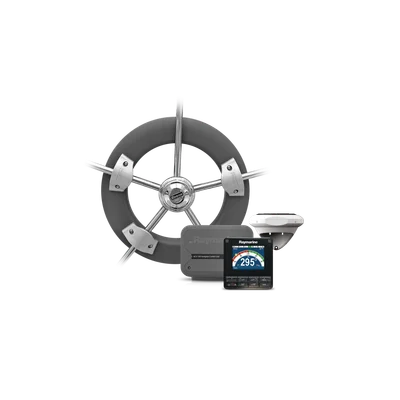
Both are Raymarine tiller autopilots and both push the tiller from a cockpit socket, so owners of tiller boats between about 26 and 34 feet ask this constantly. The ST2000+ is the self-contained classic. The EV-100 Tiller keeps a cockpit drive but moves the brain below deck: an EV-1 nine-axis sensor, an ACU-100 course computer and a p70s control head.
The difference is entirely in how the boat is steered. The EV-1 knows how the boat is pitching and rolling and corrects heading before the fluxgate in an ST2000+ has noticed the boat has yawed. On a broad reach across Broken Bay in a nor'easter that is the difference between a straight wake and a lazy S.
Side by side
ST2000+ vs EV-100 Tiller: specifications and installation
| Criterion | Raymarine ST2000+ | Raymarine EV-100 Tiller |
|---|---|---|
| Sensor | Fluxgate inside the cockpit unit | EV-1 nine-axis sensor below deck |
| Course keeping downwind | Wanders; struggles above 20 knots | Noticeably tighter; Hydro-Balance helps |
| Rated displacement | 4,500 kg | 6,000 kg |
| Control | Keys on the unit | p70s head, Axiom, optional remote |
| Wind steering | With SeaTalk/NMEA 0183 wind data | With SeaTalkng/NMEA 2000 wind data; true or apparent |
| Installation | Socket and power; owner-fit | Socket, sensor, ACU, head, backbone; half a day to a day |
| Indicative price (AUD) | $1,150–1,500 | $2,900–3,400 |
| Backup value | Great as a spare in a locker | Drive alone is not self-contained |
Specifications and installation scope from manufacturer documentation. Any AUD prices shown are indicative; confirm current package contents and installed costs with a dealer.
Which should you choose?
Choose if
Which autopilot configuration suits your boat?
Choose ST2000+ if…
- Budget under $1,500
- Boat under about 3 tonnes
- You want a unit you can remove and stow
Choose EV-100 Tiller if…
- You want proper course keeping in a seaway
- You run or plan Raymarine instruments and an Axiom
- You sail overnight or shorthanded
Assess a replacement as an installation, not a plug-in swap
When replacing an existing ST2000+, record its mounting arrangement, power connection and any instrument connections. Ask the supplier which parts can be retained with the exact replacement proposed. Similar-looking tiller installations should not be assumed to share every fitting or electrical requirement.
An EV-100 Tiller proposal should identify the complete system and the locations of its separate components. Include wiring routes and protected mounting space in the survey. The change can affect more of the boat than the removable actuator visible in the cockpit.
Choose the level of integration you need
For an owner seeking simple heading control, the decision starts with adequate drive suitability and straightforward operation. For an owner seeking integration with instruments, document the supported functions and the additional components needed to achieve them.
Ask for a quote that includes accessories, installation and setup rather than comparing a standalone unit price with a complete system price. Before purchasing either option, confirm suitability for the loaded vessel and mounting geometry; an electronics upgrade does not remove an actuator’s mechanical limits.
Questions
ST2000+ vs EV-100 Tiller: frequently asked questions
Does the EV-100 Tiller drive push harder than the ST2000+?
The thrust is similar; the difference is in the sensor and course computer, not the drive. The EV-100 is rated for heavier boats mainly because it steers more efficiently, making fewer and better corrections.
Can I reuse my ST2000+ drive with an EV-1?
No. The ST2000+ is a sealed unit. The EV-100 Tiller pack has its own drive that connects to the ACU-100.
Autopilot training after installation
The best pack badly understood is a worse autopilot than a modest one used well. A half-day handover covers modes, override, alarms and a failure drill.